
+212772661260
info@triptikum.com
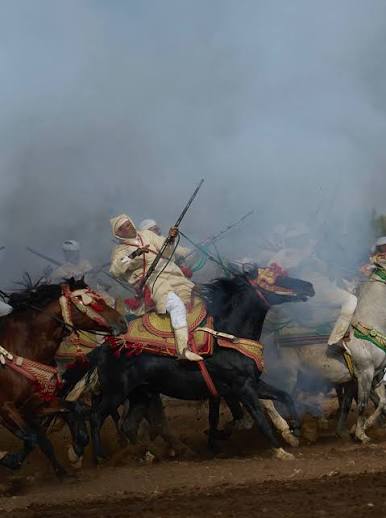
Tbourida, also known as Fantasia, is one of the most spectacular traditional performances in Morocco. It combines horses, traditional clothing, music, and coordinated movements to create a cultural show that reflects Morocco's history and heritage.
For visitors to Morocco, watching a Tbourida performance can be a memorable way to discover an important part of Moroccan culture.
The tradition is especially popular during festivals, weddings, moussem celebrations, and cultural events across the country.
Tbourida is a traditional Moroccan equestrian performance performed by groups of horse riders.
The riders, known as fantasia riders, wear traditional Moroccan clothing and ride specially trained horses. They move together in a coordinated formation before performing a famous synchronized charge.
At the end of the performance, the riders traditionally fire their old-style rifles into the air at almost the same moment, creating a loud sound known as the baroud.
This combination of horses, traditional clothing, music, and synchronized movement makes Tbourida one of the most recognizable cultural performances in Morocco.
Tbourida has its roots in Morocco's equestrian traditions and is connected to the country's historical relationship with horses and horsemanship.
Historically, horses played an important role in transportation, communication, ceremonies, and military traditions.
Over time, demonstrations of horsemanship became part of public celebrations and cultural gatherings.
Today, Tbourida is generally presented as a cultural and traditional performance rather than a military activity.
The tradition has been passed from one generation to another and remains popular in many Moroccan regions.
Tbourida represents more than horse riding. It brings together several elements of Moroccan heritage.
The performance can include:
This makes Tbourida a particularly interesting experience for travelers who want to discover Moroccan culture beyond the famous tourist attractions.
Horses have played an important role in Moroccan history and culture for centuries.
Morocco has a strong tradition of horse breeding and horsemanship, with the Barb horse and Arab-Barb horse being particularly associated with the country's equestrian heritage.
During Tbourida, the relationship between the rider and the horse is an important part of the performance.
The horses are carefully trained so that riders can perform their movements together with precision.
The clothing worn by Tbourida riders is an important part of the visual experience.
Riders commonly wear traditional Moroccan garments such as the djellaba, caftan-style clothing, turbans, and other regional clothing.
They may also carry traditional weapons and wear accessories associated with Moroccan equestrian traditions.
The exact clothing can vary depending on the region and the occasion.
This combination of horses and traditional dress gives Tbourida its distinctive Moroccan character.
A Tbourida performance usually involves a group of riders arranged in a line.
The riders begin by moving their horses in a coordinated manner. They then prepare for the final charge.
At the appropriate moment, the group accelerates together while maintaining formation.
The riders then raise their rifles and fire a synchronized ceremonial shot.
The precision required is one of the most impressive parts of the performance.
For spectators, the sound of the horses and the synchronized firing creates a powerful atmosphere.
Tbourida can be seen in different parts of Morocco, particularly during traditional festivals and moussem celebrations.
It is not limited to one city or region.
Performances can take place in rural areas, villages, towns, and larger cultural events.
Some important occasions where visitors may encounter Tbourida include:
If you are interested in seeing Tbourida during your Morocco trip, it is worth checking local festival calendars because performances are often connected to specific events and dates.
The connection between Tbourida and Morocco's moussem traditions is particularly important.
A moussem is a traditional gathering that can have religious, cultural, agricultural, or community significance.
These events often bring together people from surrounding villages and towns.
Depending on the event, visitors may find traditional food, markets, music, dancing, handicrafts, and Tbourida performances.
This makes a moussem an excellent opportunity to experience Moroccan culture in a lively local environment.
Tbourida can also be associated with important celebrations and weddings in some Moroccan communities.
A traditional horse performance can make a celebration more spectacular and can represent pride, hospitality, and cultural identity.
The exact customs vary from one family and region to another, so not every Moroccan wedding includes Tbourida.
Morocco's cultural heritage is extremely diverse, and different regions have their own traditions.
In areas where Amazigh communities are prominent, horse riding and local celebrations can be connected with regional customs and traditions.
Tbourida should therefore be understood as part of Morocco's broader equestrian heritage rather than as a tradition belonging to only one group or one region.
For visitors, it can be tempting to see Tbourida simply as entertainment.
However, it has a deeper cultural meaning.
For many Moroccan communities, it represents traditions that have been passed down through generations.
The horses, clothing, music, weapons, and riding techniques all contribute to a cultural performance that connects modern Morocco with its historical heritage.
This is why Tbourida is an important subject for anyone interested in Moroccan culture.
Tbourida was inscribed on the UNESCO Representative List of the Intangible Cultural Heritage of Humanity in 2021 under the name "Tbourida."
This recognition highlights the importance of the tradition as part of Morocco's living cultural heritage.
Unlike a historic building or archaeological site, intangible cultural heritage refers to traditions, knowledge, skills, and practices that communities continue to transmit and practice.
Tbourida is therefore a living part of Moroccan heritage.
If you are visiting Morocco, experiencing Tbourida can give you a different perspective on the country.
Instead of only visiting famous monuments, you can discover a living tradition involving local communities.
Tbourida is particularly interesting for travelers who enjoy:
It can be especially memorable when experienced during a local festival or moussem.
When attending a Tbourida event, remember that it is a cultural tradition and not simply a performance created for tourists.
A few simple things can make your visit more respectful:
The horses can move quickly, so spectators should always remain in designated viewing areas.

Comments