
+212772661260
info@triptikum.com
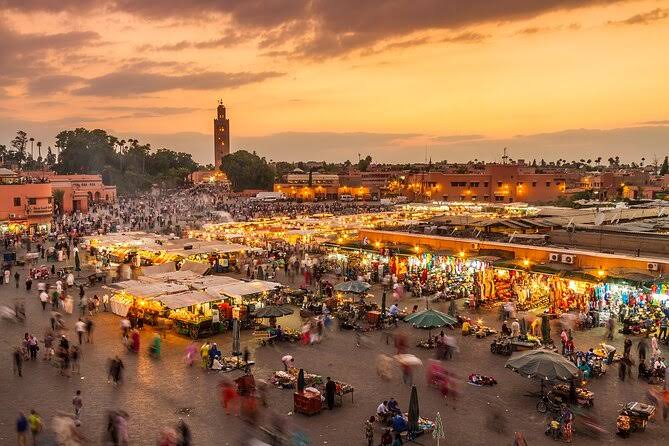
If you are planning a trip to Marrakech, Jemaa el-Fna is one place you should not miss. Located at the entrance of the Marrakech Medina, this famous square is where Moroccan food, music, entertainment, local traditions and everyday life come together.
For many first-time visitors, however, Jemaa el-Fna can feel confusing. You may hear different pronunciations of its name, see performers asking for money, encounter people offering tours or henna, and wonder what you should or should not do.
This guide explains everything you need to know before visiting Jemaa el-Fna Square in Marrakech, including how to pronounce its name, what to do, when to visit, whether it is safe, and how to deal with common tourist scams.
Jemaa el-Fna is the famous central square of Marrakech and one of the most important cultural spaces in Morocco.
The square has been associated with Marrakech for centuries and became a symbol of the city. UNESCO describes it as a place where popular Moroccan cultural traditions are expressed through music, storytelling, artistic performances and social activities. It was added to UNESCO's Representative List of the Intangible Cultural Heritage of Humanity in 2008, following its earlier recognition in 2001.
It is also part of the wider historic Medina of Marrakech, which has been a UNESCO World Heritage Site since 1985. UNESCO describes Jemaa el-Fna as an "open-air theatre" that remains an important part of the city's cultural character.
Unlike a museum or monument, Jemaa el-Fna is a living public space. You do not simply visit it and look at buildings. You walk around, watch people, listen to music, eat, drink fresh juice and experience the atmosphere of Marrakech.
One of the first questions visitors ask is:
How do you pronounce Jemaa el-Fna?
You will see the name written in several ways:
Jemaa el-Fna
Jemaa el Fna
Djemaa el-Fna
Jamaa el Fna
Djemaa El Fna
A simple English approximation is:
"Jemaa el-Fna" → "Jem-ah el-Fna"
The "J" is pronounced more like the sound in the English word "measure" in many common pronunciations, while the beginning of Fna is pronounced quickly.
Do not worry about having a perfect Moroccan Arabic accent. If you say "Jemaa el-Fna", people in Marrakech will understand what you mean.
You can also simply say:
"Jemaa Square"
when speaking with other travelers.
The meaning and historical origin of the name are more complicated than a simple translation.
The word Jemaa is associated with the ideas of assembly and mosque, while Fna has been interpreted in different ways. You may therefore find different explanations of the name in books and websites.
Rather than focusing too much on the literal translation, it is better to understand what the square represents today: a historic meeting place at the heart of Marrakech's Medina.
There is no single way to experience Jemaa el-Fna. The square changes throughout the day.
During the daytime, Jemaa el-Fna has a different atmosphere from the evening.
You can walk around, see juice sellers, traditional performers and people going about their daily activities.
It is a good time to visit if you want to take photographs and understand the layout of the square before it becomes busier.
For many visitors, evening is the best time to experience Jemaa el-Fna.
As the sun goes down, the square becomes much more active. Food stalls appear, smoke rises from the grills, musicians perform and groups of people gather around different performers.
The Moroccan National Tourist Office also highlights Jemaa el-Fna as one of the places where visitors can experience Marrakech's culture, food, performances and atmosphere both during the day and at night.
If you only have time to visit once, consider coming around sunset and staying into the evening.
One of the most famous experiences at Jemaa el-Fna is eating at the temporary food stalls.
Depending on the season and the stalls operating that evening, you may find Moroccan dishes and snacks such as:
Harira
Brochettes
Moroccan salads
Grilled meats
Tanjia
Bread
Fresh juices
Snails
Moroccan sweets
The food stalls are part of the atmosphere, but remember that prices can vary.
Always ask for the price before ordering.
If you are unsure about the price, ask:
"How much?"
or in Moroccan Arabic:
"Bshhal?"
It is a very useful word to know when shopping or eating in Marrakech.
Fresh orange juice is one of the classic experiences in Marrakech.
You will see juice stands around Jemaa el-Fna, especially during the daytime.
Before taking a glass, confirm the price. A simple:
"Bshhal?"
will help you avoid misunderstandings.
Music is an important part of Jemaa el-Fna's cultural atmosphere.
UNESCO specifically identifies musical performances, storytellers, poets, Gnaoua musicians and other traditional performers as part of the cultural space of the square.
You may not understand everything being performed, but you can still enjoy the atmosphere.
One of the most important traditions connected with Jemaa el-Fna is oral storytelling.
Traditional storytellers perform in front of groups of people, creating circles known as halqa.
These performances are an important reason why UNESCO recognizes Jemaa el-Fna's intangible cultural heritage. The cultural value of the square is not only its food or tourism; it is also the traditions and knowledge passed from one generation to another.
If you see a circle of people listening to a performer, stop for a moment and observe.
One of the best ways to appreciate Jemaa el-Fna is from above.
Several cafés and restaurants around the square have rooftop terraces where you can sit with a Moroccan mint tea or something to eat.
From a rooftop, you can see:
The square
The Medina
The surrounding rooftops
The Koutoubia Mosque and its famous minaret
The changing atmosphere from afternoon to evening
Sunset is particularly beautiful.
Yes, Jemaa el-Fna is generally a place where tourists can visit and enjoy themselves, but you should use normal precautions.
The square is busy and popular, so the main problems visitors should be aware of are usually things such as pickpocketing, aggressive selling, unwanted approaches and tourist scams, rather than simply being afraid of the square itself.
The official Marrakech tourism information specifically advises visitors to keep an eye on their belongings and be aware of pickpockets, particularly around Jemaa el-Fna.
Like any busy tourist destination, keep your phone, wallet and passport secure.
Keep your phone and wallet somewhere secure.
Avoid displaying large amounts of cash.
Keep your bag closed.
Be careful in large crowds.
Do not follow strangers into quiet areas.
Agree on prices before buying something.
Do not accept an unsolicited service simply because someone approaches you.
If you feel uncomfortable, walk away and move toward a busy area or a police/tourist assistance point.
This is one of the most important things for first-time visitors.
Not everyone who approaches you is a scammer. Many people are simply trying to sell a service or product.
However, some approaches can become uncomfortable if you do not understand how the situation works.
The best strategy is simple:
Someone may approach you and say:
"Come, come, look!"
or:
"It's free!"
You do not have to follow them.
A polite:
"No, thank you."
and continuing to walk is usually enough.
You do not need to give a long explanation.
If someone offers you something for free, ask yourself why.
This can include:
Henna
Photos
Directions
Performances
A "free" demonstration
Someone showing you a shop
Someone offering to guide you
Sometimes the service may not actually be free, or the person may expect payment afterward.
A good rule is:
If you want the service, ask the price before accepting it.
This is particularly important for:
Food
Henna
Photos
Performances
Small services
Taxis
Guided visits
Ask:
"How much?"
before you accept.
If the price is too high, simply say no.
If you have a disagreement about a price, stay calm.
You do not need to become angry or shout.
If you clearly agreed to a price beforehand, show that you understood the agreement. If you did not ask the price in advance, try to resolve the situation calmly.
The best way to avoid the problem is to agree on the price before the service begins.
You may meet people around the Medina offering to show you a shortcut or guide you somewhere.
If you want a guide, use a licensed or properly arranged local guide rather than simply accepting an offer from someone who approaches you.
If somebody says:
"The road is closed. I know another way."
do not automatically believe them.
If you are lost, use a reliable map, ask your hotel or riad, or contact an official tourism service.
This is a useful rule throughout Marrakech's tourist areas.
Someone may tell you:
"This attraction is closed."
and then offer to take you somewhere else.
Before following them, check the information yourself.
If you already know where you want to go, simply say:
"No thank you, I know the way."
and continue walking.
If somebody refuses to leave you alone, do not get into a long argument.
Walk toward:
A busy area
A shop
Your hotel or riad
A police officer
A tourist assistance point
The Marrakech tourism information also provides contact details for the tourist police brigade near Jemaa el-Fna.
Your priority is to remain calm and move away from the situation.
Be careful.
Some performers may expect payment if you take their photograph.
The safest approach is to ask first.
You can say:
"Photo?"
and show your camera.
If they indicate that they want payment, decide whether you are comfortable paying before taking the photograph.
This is especially important with performers and people who pose for tourists.
You may see snake charmers and other performers around the square.
Do not assume that watching or photographing a performance is free.
If you want a photo or interaction, ask about the price first.
Also remember that animals used in tourist performances raise ethical concerns for many travelers. You can enjoy the atmosphere of Jemaa el-Fna without participating in every attraction.
You do not need to be afraid of the square, but there are some simple things you should avoid.
Carrying large amounts of cash
Showing expensive jewelry unnecessarily
Accepting "free" services without asking questions
Taking photographs without permission
Buying something without knowing the price
Following strangers to unknown locations
Getting into arguments
Leaving your phone on a table near the edge of a busy area
Assuming every person offering help is an official guide
The square is quieter.
Best for: photographs, walking and seeing the area without large crowds.
The square becomes more active.
Best for: juice, walking and combining your visit with the souks and Medina.
This is one of the most enjoyable times.
Best for: rooftop views, photographs and watching the square change.
This is when Jemaa el-Fna becomes most famous for its food stalls, performers and busy atmosphere.
Best for: food, music, entertainment and experiencing the lively side of Marrakech.
You can see the square in 30 minutes, but that does not mean you have experienced it.
For a relaxed visit, allow around 2–3 hours.
For example:
5:00 PM: Walk around the Medina and souks
6:30 PM: Visit a rooftop café
7:00 PM: Watch the sunset
7:30 PM: Explore the square
8:00 PM: Try Moroccan food
9:00 PM: Walk around and enjoy the performances
You can easily combine Jemaa el-Fna with the Koutoubia Mosque, souks, Bahia Palace, Badi Palace and other attractions in the Medina.
Absolutely.
Even if you are not interested in shopping or organized entertainment, Jemaa el-Fna is worth visiting because it gives you a chance to experience Marrakech's public life.
The square is not simply a tourist attraction. It is a cultural space where people meet, eat, perform, trade and socialize.
UNESCO's recognition is particularly important because the heritage of Jemaa el-Fna is based on its living traditions and cultural practices, including storytelling, music and performing arts.
Before you visit, remember these simple rules:
1. Learn the name: Jemaa el-Fna is pronounced approximately "Jem-ah el-Fna."
2. Visit around sunset: This is when the square starts becoming particularly lively.
3. Ask prices first: Especially for food, photos, henna and other services.
4. Say no politely: You do not need to accept every offer.
5. Keep your belongings secure: Jemaa el-Fna can become very crowded.
6. Ask before taking photographs: Some performers expect payment.
7. Do not follow unofficial guides: If you need a guide, arrange a legitimate one.
8. Stay calm: If someone approaches you aggressively, walk away rather than arguing.
9. Enjoy the culture: Listen to the music, watch the storytellers and experience the atmosphere.
10. Explore beyond the square: Jemaa el-Fna is the gateway to the fascinating streets and souks of Marrakech's Medina.
Jemaa el-Fna is one of the places that makes Marrakech different from other cities.
During the day, it is a meeting place in the heart of the Medina. At night, it becomes a lively open-air space filled with food, music, performers and people.
It is safe to enjoy when you use common-sense precautions. You do not need to be nervous about every person who approaches you, but you should understand that this is a busy tourist area where some people may try to sell you services aggressively or charge unexpected prices.
The secret is simple: ask the price first, politely say no when you are not interested, protect your belongings and enjoy the experience.
Most importantly, take time to look beyond the tourist activity. Jemaa el-Fna is a living part of Marrakech's cultural heritage, and that is what makes a visit here so memorable.

Comments