
+212772661260
info@triptikum.com
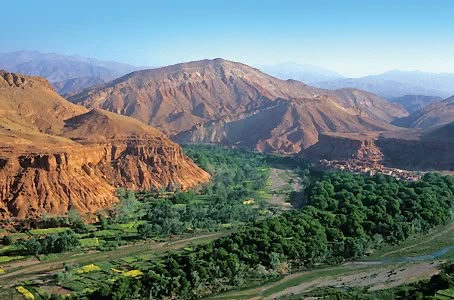
Hidden in the mountains of southern Morocco, Bou Tharar is a small Amazigh village located in the famous Valley of Roses near Kelaat M’Gouna. Surrounded by red mountains, green agricultural fields, traditional earthen houses and the M’Goun River, Bou Tharar offers a very different experience from Morocco’s better-known tourist destinations.
The village is particularly interesting for travelers who enjoy hiking, nature, traditional villages and authentic Moroccan culture. It is also an important starting point for exploring the M’Goun Valley and the surrounding High Atlas mountains.
While many visitors travel through Kelaat M’Gouna to see the famous roses, fewer continue deeper into the valley toward Bou Tharar. This makes the area a peaceful destination for travelers looking to experience rural Morocco away from the busiest tourist routes.
Bou Tharar is located in the Valley of Roses, in the province of Tinghir, in southeastern Morocco. The village lies in the High Atlas region and is connected with Kelaat M’Gouna by a mountain route through the Valley of Roses.
Kelaat M’Gouna is the main town and an important stop for travelers visiting the valley. It is well known as Morocco's Rose Capital because of the large-scale cultivation and processing of Damask roses.
From Kelaat M’Gouna, the landscape gradually changes as you travel toward Bou Tharar. Green fields, rose bushes, palm trees, traditional villages and colorful mountain landscapes create a beautiful route for photographers and nature lovers.
The area between Kelaat M’Gouna and Bou Tharar is commonly known as the Valley of Roses. In spring, the valley becomes especially beautiful when the rose bushes begin to flower.
The roses are traditionally cultivated along agricultural fields and irrigation channels. Their petals are collected and used to produce products such as rose water, rose oil, perfumes, soaps and cosmetics.
The rose harvest is one of the most important agricultural traditions in the region. If you visit during the flowering season, you can see a very different side of southern Morocco, with the scent of roses filling parts of the valley.
Kelaat M’Gouna also hosts its famous Rose Festival, which celebrates the local rose harvest and traditions.
One of the biggest attractions of Bou Tharar is its authentic atmosphere.
Instead of large hotels, busy streets and large numbers of tourists, you will find traditional villages, agricultural terraces, mountain landscapes and local homes. The area is closely connected to Amazigh culture and rural life.
Traditional houses are often built from earth and mud, using materials that naturally blend into the surrounding landscape.
The valley is also an excellent place to see how agriculture has adapted to the dry environment of southern Morocco. The M’Goun River provides water for fields, gardens and trees, creating green areas between the surrounding rocky mountains.
Bou Tharar is particularly attractive for travelers interested in hiking in Morocco.
From the village and surrounding area, several trails lead through valleys, villages and mountain landscapes. One of the notable areas is the route toward Aifër and the M’Goun Valley, where hikers can follow the river through a landscape of green vegetation and dramatic rock formations.
For experienced hikers, Bou Tharar can also be connected with longer M’Goun trekking routes. The M’Goun massif is one of the major mountain areas of the Moroccan High Atlas, making the region an excellent destination for multi-day trekking.
For longer hikes, especially in remote mountain areas, hiring a local mountain guide is recommended.
One of the best reasons to visit Bou Tharar is the opportunity to experience everyday Amazigh life in southern Morocco.
The villages around the Valley of Roses have preserved many traditional customs. Agriculture, livestock, family life and local crafts remain important parts of the community.
Walking through the villages gives visitors the opportunity to see traditional architecture and agricultural landscapes that are very different from Morocco's major cities.
A visit can also be combined with a traditional Moroccan tea experience or a stay in a local guesthouse, allowing travelers to learn more about the people and culture of the region.
Traditional kasbahs are another important part of the landscape around Bou Tharar.
Built mainly from earth, these old structures feature towers, decorated walls and defensive architectural elements. Their reddish and brown colors blend beautifully with the surrounding mountains.
Some kasbahs have suffered from time and weather, but they remain an important part of the cultural heritage of the Valley of Roses.
For photographers, early morning and late afternoon are particularly good times to photograph the kasbahs because the sunlight creates strong contrasts between the buildings and the mountains.
The best time to visit Bou Tharar depends on what you want to experience.
Spring is one of the best seasons for visiting the Valley of Roses. From around April into May, the rose-growing areas become especially interesting as the flowers bloom and the harvest begins.
This is also the best period if your main goal is to experience the famous rose culture of Kelaat M’Gouna.
Autumn can also be a pleasant time for hiking and exploring the valley. Temperatures are generally more comfortable than during the hottest summer months.
Summer can be hot during the day, although mountain areas can be cooler in the evening. If you plan to hike, starting early in the morning is a good idea.
Winter is quieter, but temperatures can become cold in the mountains, particularly at night.
Kelaat M’Gouna is the main access point for travelers visiting Bou Tharar.
The journey takes you deeper into the Valley of Roses, passing traditional villages and agricultural landscapes. The final part of the route can be more rural and less developed than the main roads in the region, so road conditions should be considered when planning your trip.
For visitors traveling by private vehicle, a comfortable vehicle suitable for mountain roads is a good choice.
If you are traveling as part of a Morocco tour, Bou Tharar can be combined with Kelaat M’Gouna, the Valley of Roses, Dades Valley and the M’Goun region.

Comments